
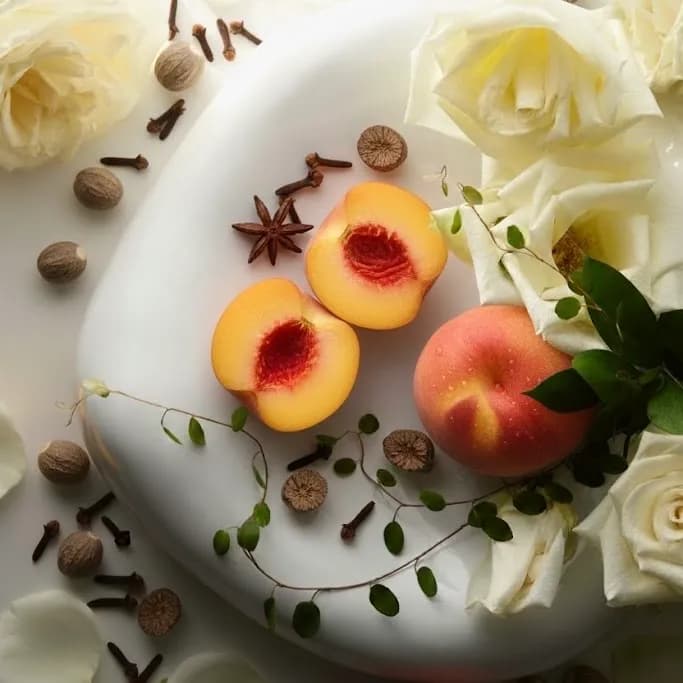
The physics behind it: volatility
Fragrance molecules differ in size and, with it, in volatility. Small, light molecules — citrus peel, many herbs — evaporate quickly: you smell them at once and barely at all after a quarter of an hour. Large, heavy molecules — resins, woods, vanilla materials — evaporate sluggishly: they take a while before you even notice them, but then hold on for hours.
A perfumer composes with precisely this gradient. The pyramid, then, is not a list of ingredients by quantity but a timetable: at the top what arrives first and leaves first, at the bottom what stays.
The top note: the opening line
The top note is what you smell in the first minutes — usually citrus, fresh herbs, light spices. It decides the first impression and is at the same time the most fleeting part of the fragrance: after ten to twenty minutes its appearance is over.
Hence the most important advice in this article: never buy on the first spray. The fragrance you smell on the paper strip in the shop is almost pure top note — precisely the part that disappears fastest.
The heart note: the actual fragrance
Once the top note has gone, the heart takes over — classically the flowers and the fuller spices. The heart note carries the character of the perfume through the next hours; it is what others notice when they meet you. When a fragrance “turns”, it usually happens here: the transition from fresh top to floral heart is the trickiest point of any composition.
The base note: what stays
The base consists of the heaviest materials — woods, resins, patchouli, vetiver, vanilla, tonka. It needs half an hour or longer to unfold and then carries the fragrance into the evening. What you still faintly smell on your wrist the next morning is pure base.
The base is also the reason two fragrances with a similar opening can develop in completely different directions: a citrus top over dry vetiver tells a different story from the same top over sweet vanilla.
Reading the pyramid — with an example
Take the pyramid Wyld Notes publishes for Smokey Ember: lemon and juniper in the top, jasmine and clary sage in the heart, cypress and black spruce in the base. Read as a timetable, that means: the fragrance opens bright and clear, turns floral and herbal — and ends in a conifer forest. Whoever tests only the opening takes it for a fresh scent; whoever knows the base knows it ends up in the woods.
Every pyramid can be translated into one sentence this way: first A, then B, C at the end. It is worth forming that sentence consciously once before you buy.
What this means for your next test
Give a fragrance time — an hour at least, better half a day — and smell in stages: after five minutes, after half an hour, in the evening. Only then have you heard all three levels. And read the pyramid beforehand: it tells you whether the ending suits the beginning.